AgroWatts S.A. de C.V. · First Mexican company 100% focused on agrivoltaics · Founded in 2023
AgroWatts
AgroWatts Studio · Analyze my site

Analyze your site and generate your agrivoltaic project in 3D

Free tool for properties in Mexico: mark your land, add your CFE electricity use and press Generate. You get the 3D model, estimated power and energy, what your tariff implies, how much of your consumption you would cover, the incentives that may apply and a preliminary report you can save as PDF or send by WhatsApp.

1

Your land

Upload your KMZ/KML or draw the polygon by tapping each corner on the map.

0hectares
0vertices
-source


2

Your electricity consumption

Upload your CFE bill or calculate from your equipment or what you pay. It is optional.

Calculate consumption

Estimated annual consumption: no data


3

Generate

Combine land and consumption into a preliminary report with a 3D design.

Calculated in your browser. Preliminary estimate; AgroWatts validates it with a visit or video call.

Example: Dachimilco (Xochimilco, CDMX). 72 modules of 635 W in 4 rows of 18 = 45.72 kWp. Preview; the 3D model loads only if you open it. When you generate your project, this example is replaced by yours.

Double-harvest finance

CAPEX · OPEX · ROI simulator

Explore the assumptions of an agrivoltaic investment compared with continuing to farm without panels. It is not a quotation or a bankable study.

Preloaded example: Dachimilco (Xochimilco, CDMX). 72 modules of 635 W in 4 rows of 18 on an elevated structure = 45.72 kWp, Valle de México Sur division. Tariff, consumption, costs and crop are editable assumptions, not measured project data. See the design in Analyze my site

Your CFE bill and your system

Off by default: reducing billable demand requires your 15-minute load profile. The 0.57 factor per tariff is NOT VERIFIED. The avoided tariff excludes the fixed charge, VAT and DAP.

Effective avoided tariff
-
Surplus value
-
Estimated CAPEX
-
Electrical system
-
Demand
-

CAPEX per kWp: turnkey PV system without VAT by scale; with an elevated structure the indicated surcharge is added (Fraunhofer ISE, +73 %). It excludes batteries (BESS), irrigation system, major civil works, permits and interconnection works.

Sources for tariffs, PML and CAPEX

CFE rates of October 2026 without VAT. Tariffs with demand: billable demand is the lower of maximum demand and kWh/(24 x days x 0.57), so each solar kWh can lower ~1/416 billable kW if your load factor is below 57%. For GDMTH, 80% of solar energy is assumed in the intermediate period and 20% in base, and only distribution is credited (capacity is measured at peak). 9-CU and 9-N apply up to the energy quota; the surplus is billed at RABT or RAMT. DIST and DIT (high voltage) require a specific study. PML: 2025 system average; the real value depends on the node and the hour.

Without it, straight-line depreciation of 10% per year applies. It requires the equipment to operate for at least 5 years and sufficient taxable profit. LISR (DOF)

See details: Sources and assumptions
Total investment-
Energy year 1-
Year 1 savings after O&M-
No incentive or loan
NPV-
IRR-
Payback-
Own investment-
Selected scenario
NPV-
IRR-
Payback-
Own investment-
Cumulative incremental cash flow (MXN, before debt and taxes)

Illustrative estimates, not a quotation or tax or financial advice. Cash flows after income tax; the loan uses fixed payments and interest is treated as deductible. Confirm with your accountant and the financial institution.

Credit references / Sources and assumptions
  • NAFIN Eco Crédito Solar Up to 15 million pesos, fixed rate up to 16% per year, term up to 8 years, SMEs on CFE tariff PDBT, GDBT, GDMTO or GDMTH.
  • FIRA: credit through intermediaries + FONAGA Verde Equipment credit for renewable energy projects in the agri-food sector; FONAGA Verde covers 50% or 80% guarantees. Rate and term depend on the intermediary.
  • FIRA ProSostenible In force (updated 18 Sep 2026). Free guarantee with a first-loss reserve of 20% (long term) or 5% (short term), loans up to 10 million UDIS and a rate reduction of 100, 250 or 400 basis points depending on stratum and municipality. Requires a Technical Eligibility Certificate at prosostenible.org, FIRA-funded credit through an intermediary and a positive SAT opinion.
  • FIDE / NAFIN Eco-Crédito Empresarial Relaunched by FIDE, NAFIN and SENER (Sep 2026): up to 1 million pesos for distributed-generation photovoltaics (with a bidirectional meter) and up to 2 million for other technologies; fixed rate up to 13% + VAT, up to 60 months, charged on the CFE bill, no prepayment penalty.
  • Income Tax Law, art. 34 fr. XIII
Directory

Tax incentives, subsidies and financing in Mexico

Federal, state and municipal programs that apply to solar energy on farms. Each links to its source; we reviewed the status on 4 November 2026. State calls usually open once a year.

Full directory (27 programs, filterable)

27 programs. In force To be confirmed Closed 2026 Not in force

In force (law)Federal·Tax

100 % immediate deduction of investment in renewable energy equipment (LISR art. 34 sec. XIII)

Allows deducting 100 % of the machinery and equipment that generate energy from renewable sources in the year of acquisition; the equipment must operate for at least 5 years.

Official source
In force (law)Federal·Regulation

Distributed generation under 0.7 MW without a CNE permit (Electricity Sector Law 2025)

Plants under 0.7 MW are exempt generation; they interconnect with CFE through procedure 360 of the Single Window.

Official source
In force (annual enrollment)Federal·Tariff

Special Energy Program for the Countryside: tariffs 9-CU and 9-N

Preferential electricity tariff for agricultural pumping and re-pumping; requires annual enrollment with SADER. It reduces the direct savings of a solar system.

Official source
In forceFederal·Credit

FIRA: Cosechando Soberanía

Credit of up to $1,300,000 per producer at a preferential rate of up to 8.5 % per year, through financial intermediaries.

Official source
To be confirmedFederal·Guarantee

FIRA: FONAGA Verde

Guarantee for loans to sustainable projects, including renewable energy, through intermediaries.

Official source
To be confirmedFederal·Credit

FIRA: ProSostenible

Financing and support for sustainable agricultural projects (energy efficiency, renewables).

Official source
In forceFederal·Credit

FIDE: Eco-Crédito Empresarial

Financing for small and medium businesses for efficient equipment and photovoltaic systems, repaid on the CFE bill.

Official source
In force (2026 announcement)Federal·Credit

FIDE: expansion of credits for small and medium businesses (2026)

Announcement of larger amounts for distributed generation and efficient equipment.

Official source
To be confirmedFederal·Credit

NAFIN: Eco Crédito Solar

Credit for solar systems in businesses through intermediaries.

Official source
To be confirmedFederal·Institutional

FIRCO: renewable energy and energy efficiency in agriculture

SADER trust fund with a track record in solar projects in agribusiness; check whether a call is open.

Official source
In force 2026Federal·Direct support

Producción para el Bienestar (SADER)

Annual support of $7,300 to $24,000 for small and medium producers of priority crops. It does not finance panels; it supplements income.

Official source
In force 2026Federal·Direct support

Operating Rules of Producción para el Bienestar 2026 (DOF)

Amounts by tier and official requirements.

Official source
To be confirmedFederal·Credit

Finabien Reforzado (Finabien with FIRA)

Announced credit scheme for small producers; no public call at the time of review.

Official source (press release)
Not in force (initiative)Federal·Credit

Banco del Bienestar: rural productive credit

Only a legislative initiative (July 2026) exists to enable first-tier credit; it is not an operating program.

Note: the official server returned 500 during verification; document located in the SIL index.

Official source
To be confirmedFederal·Grant

PPD / GEF Mexico: Phase 8 call (2026)

Grants to community organizations for environmental projects, including energy.

Official source
Closed 2026; expect 2027Jalisco·Grant

Jalisco Agrosustentable 2026: Productive Renewable Energy and Agrivoltaics

Up to 70 % of the investment, cap $150,000, for panels, solar pumping, solar irrigation and batteries. Call open March 18 to 27, 2026 (closed).

Official source
To be confirmedJalisco·Grant

Jalisco: solar panels in primary production units

50 % of the project up to $300,000 for crop, livestock and vegetable producers.

Official source
Closed 2026; expect 2027Guanajuato·Grant

SECAM QC0160 Productive Irrigation 2026: pressurized irrigation with innovative technologies

Includes solar panels and pumping with alternative energy; up to 50 % or $47,000 per hectare. Applications from January 28 to February 16, 2026 (closed).

Official source
CheckGuanajuato·Grant

SECAM: current calls

Official list of calls for the Guanajuato countryside.

Official source
Closed 2026Puebla·Grant

Puebla Energy Agency: Energía para el Campo 2026

Grid-connected photovoltaic systems for irrigation wells of farmer associations; registration until August 21, 2026 or until the budget runs out.

Note: the server did not respond from our network during verification; document located through web search.

Official source
Closed 2026Puebla·Grant

Puebla Energy Agency: Incentivos Verdes 2026 (small and medium businesses, includes agriculture)

Support for photovoltaic systems of small and medium businesses; registration until April 24, 2026.

Note: the server did not respond from our network during verification; document located through web search.

Official source
To be confirmedYucatán·Grant

Hydro-Agricultural Infrastructure Program

60 % of solar panels, pumping and irrigation, up to $500,000 per year per producer, in 75 municipalities.

Official source
In forceSonora·Credit

FIDESON: Promotion of Green Energy

Credit of $50,000 to $500,000 (80 % of the investment) for panels in agro-industrial small and medium businesses; 12 % rate (10 % for chamber members), up to 48 months.

Official source
In force (procedure)Hidalgo·State service

Hidalgo State Energy Agency: installation of photovoltaic systems

The AEEH installs off-grid or grid-connected low-voltage systems with a cost per module; the applicant buys the equipment.

Official source
To be confirmedHidalgo·Matchmaking

Hidalgo Solar Program (PROHISO)

Connects beneficiaries with companies that finance distributed generation projects.

Official source
Closed 2026Chihuahua·Tariff

SDR Chihuahua: enrollment in the Special Energy Program for the Countryside

State support to enroll in the agricultural tariff; 2026 deadline: April 28.

Official source
To be confirmed (press release)Zacatecas (Fresnillo)·Grant

Municipality of Fresnillo with FIDE: panels for micro and small businesses

Up to $10,000 from the municipality plus 10 % from FIDE and FIDE credit; aimed at businesses, not producers.

Official source (press release)

Mexico does not yet have a legal definition of agrivoltaics. The Mexican Agrivoltaics Association (AMAYAD) compiles support programs and promotes a public policy framework. Amounts, requirements and dates may change; always confirm with the agency before investing.
Methodology

How AgroWatts works

A complete agrivoltaic development follows these steps, from land data to operation.

  1. Satellite imagery study
    Illustrative image
    1

    1. Satellite imagery study

    We analyze the property, its vegetation history, shadows, access and land use.

  2. Soil laboratory tests
    Illustrative image
    2

    2. Soil laboratory tests

    We complement the information with physical-chemical analyses of the soil.

  3. Geophysical survey
    Illustrative image
    3

    3. Geophysical survey

    Electrical resistivity tomography of the subsurface with equipment from SiberGeo, our ally, for foundations and water.

  4. Multispectral drone flight
    Illustrative image
    4

    4. Multispectral drone flight

    Crop productivity maps with a multispectral sensor, with AgroByte.

  5. Basic engineering
    Illustrative image
    5

    5. Basic engineering

    We define structure, power, interconnection and crop compatibility.

  6. Exact quote
    Illustrative image
    6

    6. Exact quote

    With the studies done, we deliver a fixed price and its scope.

  7. Design
    Illustrative image
    7

    7. Design

    Detailed structural, electrical and agronomic engineering.

  8. Construction
    Illustrative image
    8

    8. Construction

    Installation of the structure, modules, inverters and protections.

  9. Operation
    Illustrative image
    9

    9. Operation

    Monitoring, maintenance and tracking of energy and harvest.

Allies

Partners and allies

We work with companies specialized in each stage of the project.

SiberGeo

SiberGeo

Manufacturer of geophysical instruments. Its electrical resistivity tomography equipment supports our subsurface studies.

Products
  • Multi-electrode resistivity and IP stations (Skala series, SibER 48K12)
  • EMS-Nemfis and AEMP-14 induction equipment
  • Geoelectrical data processing software
Website
Alfa Green Solutions

Alfa Green Solutions

New York company specialized in decarbonization as a service and energy efficiency solutions, with ESG projects in blue economy, sustainable urban development, environmental mitigation and green building.

Products
  • Plumbing systems (PEX, PP-RCT)
  • Fire protection
  • Water treatment and filters
  • Hydraulics: ball valves and Alfarapid grooved system
  • ESG projects
Website
Solar Mounts

Solar Mounts

US designer and manufacturer of commercial and utility-scale solar structures, including agrivoltaic solutions.

Products
  • Eclipse Series: solar shade structure
  • Galactic Series: solar carport
  • Delta Series: ballasted ground mount
  • Atlas Series: driven-pile ground mount
Website
AG Solar

AG Solar

Slovenian company that designs, builds and maintains agrivoltaic and solar plants.

Products
  • Agrivoltaics
  • Solar plants on degraded land
  • Ground-mounted solar plants
  • Energy storage
  • Monitoring and maintenance
Website
Reference

Structure and module types

altura libre 4 a 6 m
Elevated canopyPanels 4 to 6 m above the crop; machinery can pass underneath. Berries, vegetables, fruit trees. Illustrative image.
orientación este-oeste
Vertical bifacialVertical rows with bifacial modules; they capture morning and afternoon sun. Grains, pasture, agave. Illustrative image.
Elevated tilted between rowsTilted tables at 2.5 to 3.5 m with crop or grazing aisles. Illustrative image.
Single-axis trackerModules rotate following the sun; more energy per module and moving shade over the crop. Illustrative image.
Monofacial moduleCaptures light only on the front. An economical option for a closed canopy. Illustrative image.
albedo
Bifacial glass-glass moduleGenerates on both faces with light reflected from the ground; typical in elevated and vertical structures (like Astronergy's bifacial line). Illustrative image.
Semi-transparent moduleSpaced cells that let more light through to the crop; useful for shade-sensitive vegetables. Illustrative image.
Visual reference

What agrivoltaics looks like on Mexican farmland

Illustrations of different crops and structures. They do not correspond to AgroWatts projects.

Elevated solar canopy over strawberries in the Bajío
Elevated canopy over berries, Bajío
Illustrative image generated for AgroWatts; not a real installation.
Fixed elevated south-facing solar tables over blue agave rows in Los Altos de Jalisco. Illustrative image
Fixed elevated structure with agave, Jalisco
Illustrative image generated for AgroWatts; not a real installation.
Tractor between rows of solar trackers over maize
Trackers over maize with machinery passage
Illustrative image generated for AgroWatts; not a real installation.
Semi-transparent canopy over tomato and chili
Illustrative image generated for AgroWatts; not a real installation.
Sheep grazing under solar panels
Grazing under a tilted structure
Illustrative image generated for AgroWatts; not a real installation.
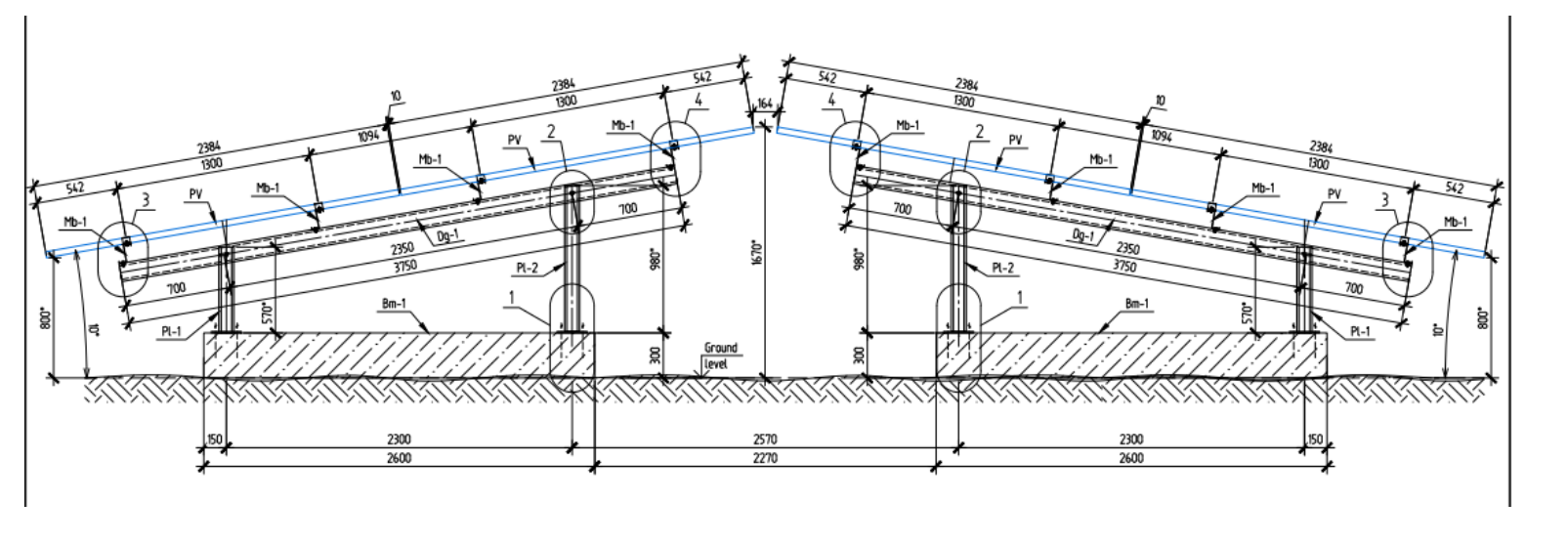
AgroWatts canopy-type structure drawing
Canopy drawing
AgroWatts technical drawing.
PREMIUM

Complete AgroWatts Live Studio

From the idea to a build-ready project: a 3D digital twin of your land with your real data.

Sun and shade in 3DHour-by-hour sun path, solstices, equinox and the May heat peak.
8 layouts comparedN-S rows, checkerboard, canopy, vertical bifacial, single-axis tracker and more, with height and tilt to your measure.
Light for every cropAverage and minimum light at foliage height, DLI and comparison with an open-sky control plot.
RainwaterLiters collected per month, gutters, cistern and what share of your irrigation it covers.
Flooding and risksFlood, hail and wind risk, plus recommended add-ons.
Energy, irrigation and batteriesInverters, pumping and storage according to your loads.
CFE bill, CAPEX and returnReading of your bill, tariff, investment, OPEX and project finances.
Carbon and waterEnvironmental impact of the project for reports and green financing.
Sensors, drones and dataKML/GeoJSON, drones and sensors; export CSV and JSON.
Executive summary and managementBuild-ready 3D summary and project tracking.
I want Studio PremiumWe will contact you to review your project and scope.

Currently available only in Mexico

AgroWatts Live Studio is currently available only in Mexico. Is your project in another country? Write to us on WhatsApp or email, or book a 15-minute consulting video call.

Frequently asked questions

About analyzing your site

What does the Analyze my site tool do?

It calculates in your browser a preliminary agrivoltaic project for a property in Mexico: area, number of 635 W modules, power in kWp, estimated annual energy (1,500 to 1,900 kWh per kWp per year), coverage of your consumption, implications of your CFE tariff, incentives that may apply and a 3D model of the structure.

What files can I upload?

KMZ or KML files from Google Earth, QGIS or Avenza for the land, and the CFE bill as a PDF to detect the tariff. Both are processed in your browser and are not sent to any server.

How is the power calculated?

About 85 % of the land is considered usable, with coverage depending on the structure: 31 % for elevated rows, 50 % for continuous canopy and 12 % for vertical bifacial. Each Astronergy N7 bifacial TOPCon module measures 2,382 × 1,134 mm and is rated 635 W. The rear-face gain is not counted.

Do I need a CNE permit?

Systems under 0.7 MW of AC capacity can be interconnected as distributed generation with CFE without a CNE permit. From 0.7 MW a CNE permit and an interconnection study with CENACE are required.

Is the result a quotation?

No. It is a preliminary, indicative estimate. AgroWatts validates it with a visit or video call, soil, wind and crop studies and your complete bill.